Stainless steel jewelry is booming. Today, customers want everyday jewelry that is waterproof, tarnish-free, and affordable.
As a jewelry brand owner or retailer, finding a reliable supplier can be hard. When you buy wholesale jewelry online, you often see terms like "Titanium Steel," "Surgical Steel," or "304 Steel." What do they really mean for your business?
Most stainless steel jewelry in the wholesale market uses one of three grades: 201, 304, or 316L. They look the same in photos. But in real life, the quality is very different. If you pick the wrong material, you will get high return rates and bad reviews.
Here is a simple, direct guide to help you make the right choice for your bulk orders.
1. 201 Stainless Steel: The Cheap (But Risky) Choice
Also called: High Manganese Steel.
Factories use 201 steel to cut costs. It has low nickel and high manganese.
Pros:
- Very Cheap: It lowers your sourcing cost. Good for dollar stores or low-end markets.
- Hard Material: It does not bend easily.
Cons:
- Rusts Fast: It turns green or black when it touches sweat or water.
- Allergy Risks: High manganese causes skin reactions.
- Bad for Business: Your customers will complain, ask for refunds, and never buy again.
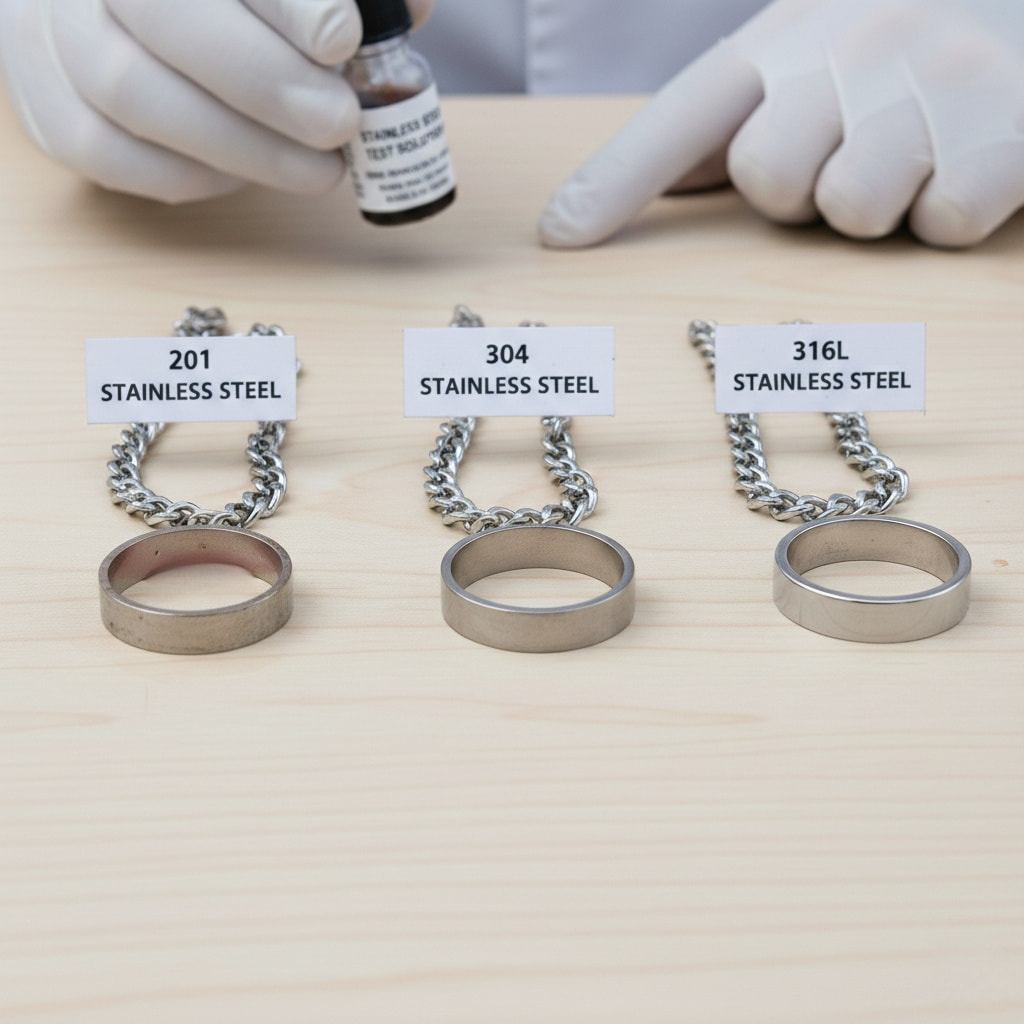
2. 304 Stainless Steel: The Middle Ground
Also called: Food Grade Steel.
This is the standard steel used in home kitchens. It is much better than 201.
Pros:
- Fair Price: A good balance between cost and quality.
- Good Basic Protection: It does not rust easily in normal, dry daily life.
- Easy to Make: Factories can polish it well to give it a nice shine.
Cons:
- Fails in Summer: It can still rust if customers wear it in the ocean (saltwater) or pool (chlorine).
- Not 100% Safe: Sensitive skin might still get mild allergies. You cannot safely market it as "100% hypoallergenic."
3. 316 and 316L Stainless Steel: The Best Choice for Brands
Also called: Surgical Steel, Marine Grade, or Titanium Steel (a common marketing name).
This is the top grade. It has added Molybdenum (Mo), which stops rust completely. 316L is the low-carbon version, making it perfect for skin contact.
Pros:
- 100% Tarnish-Free: Customers can shower, work out, or swim in the ocean. It stays shiny.
- Hypoallergenic: It is the same material used for medical tools. It is very safe for sensitive skin.
- High Profit Margin: It has a bright, heavy, premium look. You can sell it at a higher retail price.
Cons:
- Costs More Upfront: The wholesale price is higher than 201 and 304.
- Harder to Cut: Factories spend more time and labor to make complex designs.
What Happens After 6 Months? (Why Quality Matters)
As a seller, you need jewelry that lasts. Here is what happens after your customer wears the jewelry for 6 months:
- If you sell 201: The gold plating peels off. Dark rust spots show up.
- If you sell 304: The edges look cloudy and lose their shine.
- If you sell 316L: It still looks brand new. Your customers trust your brand and buy more.
Quick Summary Table for Buyers
|
Material
|
Wholesale Cost
|
Rust Proof
|
Skin Safe
|
Best For
|
|
201
|
Very Low
|
Poor
|
Poor
|
Cheap flea markets. Not recommended.
|
|
304
|
Medium
|
Good
|
Good
|
Fast fashion brands.
|
|
316L
|
High
|
Excellent
|
Excellent
|
Quality brands, long-term business.
|
How to Check Your Supplier's Quality
Don't just trust the factory label. Here is a simple way to test your bulk orders:
- Use Testing Drops:You can buy stainless steel testing liquid online. Put one drop on the bare metal.
- Turns red fast = 201
- Turns red slowly (3-5 mins) = 304
- No color change = 316L
- Check the Color:Without plating, real 316L has a slightly darker, colder silver tone. 304 looks a bit whiter.
Final Advice for Jewelry Business Owners
If you want to build a real brand, lower your return rates, and get loyal customers, buy 316L stainless steel jewelry. It costs a little more from your supplier, but it saves your brand reputation.
Looking for a reliable 316L stainless steel jewelry supplier?
At Udinery, we use premium 316L surgical steel. We offer custom designs, low MOQs, and bulk wholesale pricing.
👉 [Contact Us Today for a Free Catalog and Quote]
